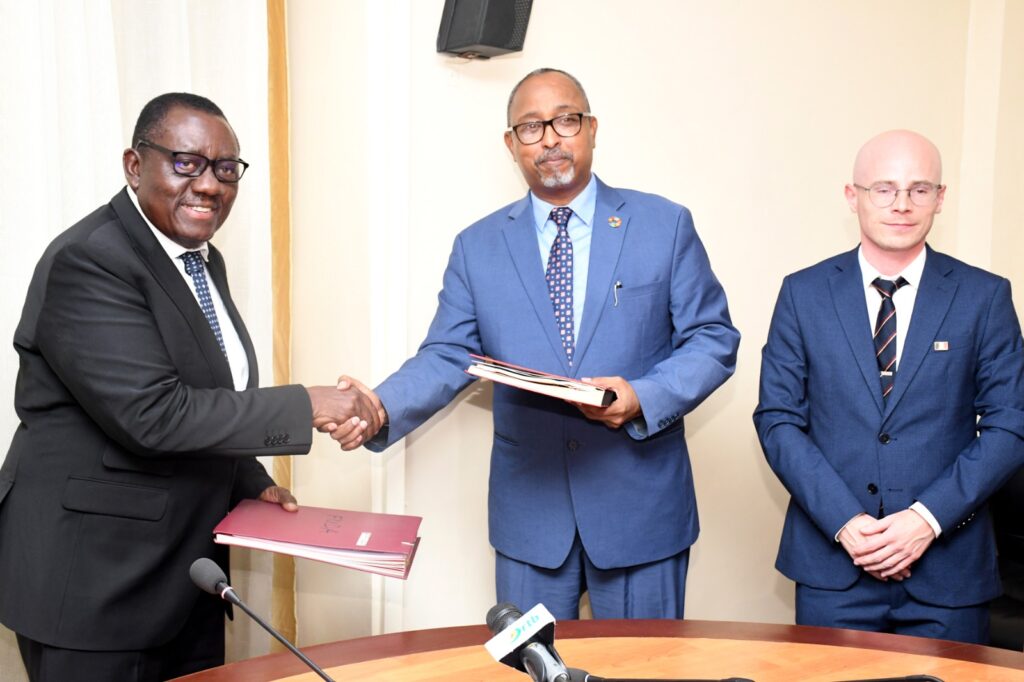
The Government of Benin and the Resident Representative of the United Nations Development Program in Benin signed, on Monday 6 February 2023, the convention of the Project for the Strengthening of the Resilience of Farming Communities in Border Zones exposed to the adverse effects of climate change (2RCAZF). A project that benefits farmers and stockbreeders and for which the Kingdom of Belgium is the main donor.
It is a specific project for the benefit of farmers and breeders in the communes of Djougou, Copargo, Ouaké and Malanville. It aims to build the resilience of these communities in Benin’s border areas that are adversely affected by climate change in order to protect their livelihoods and reduce poverty. The project also aims to contribute to mitigating the impact of agricultural activities on the climate by promoting reforestation/agroforestry, agroecological techniques, agricultural waste management and the use of renewable energy. Overall, the project aims to increase the capacity, skills and livelihoods of communities, which in turn will diversify and stabilise local economies, creating new opportunities for sustainable growth under climate conditions.
“The fact is that some communes have particular pressures due to their geographical position. These are subjects for reflection that lead to helping these poor rural populations to a certain capitalization to resist the shock,” said Gaston Dossouhoui, Minister of Agriculture, Livestock and Fisheries.
However, in order to achieve this, “we must be able to find them working materials adapted to the various climatic changes. We need to support them in agricultural capitalisation… and in the establishment of infrastructures that enable them to generate income and develop income-generating activities,” the Minister added.
The project also aims to mitigate conflicts between farmers and herders in order to create a climate of conviviality between the communities. “The fact is that in most of these proposed communes, livestock plays an important role. And you all know what lies behind the conflicts between farmers and herders due to the scarcity of pasture and water points. If, with this program, we manage to substantially resolve these issues, to bring the products of agriculture to the markets, it goes without saying that we will create the conditions for a peaceful life, a climate of peace and security for these communities,” he continued.
The Resident Representative of the United Nations Development Program in Benin, Aowalé Mohamed Abchir, paid tribute to the Kingdom of Belgium, the main donor of the project. “I would like to thank the Belgian cooperation for its commitment and determination to be involved in the fruitful dialogue with the UNDP headquarters until the formulation of the project document is completed,” he said.