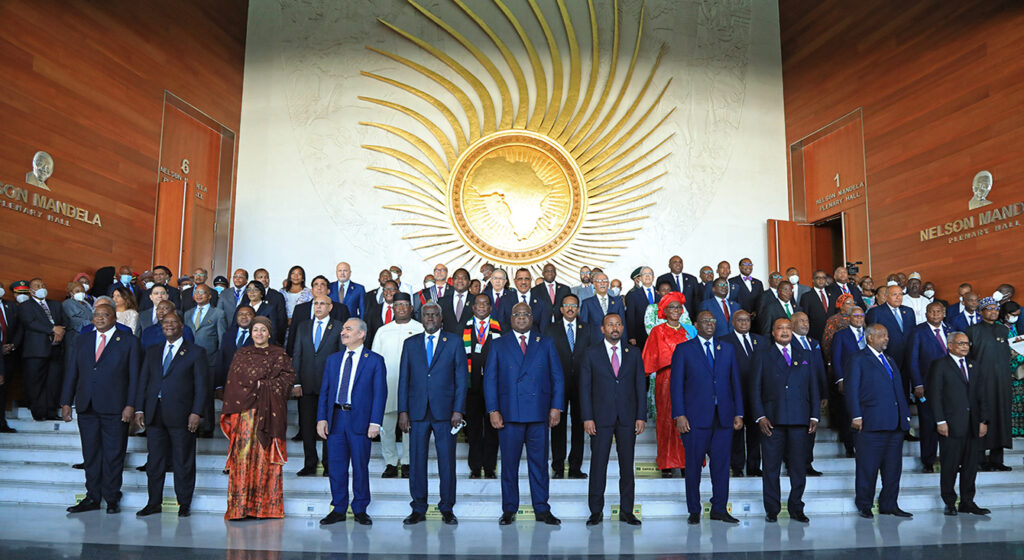
The 42nd Ordinary Session of the Executive Council of the African Union (AU) opened on Wednesday 15 February at the African Union Headquarters, Addis Ababa, Ethiopia. This was attended by leaders and officials of the AU Commission, ministers of AU member states, heads of AU organs and offices and partners.
The session, which took place on Wednesday 15 and ends on 16 February, is a prelude to the 36th Ordinary Session of the AU Summit of Heads of State and Government scheduled for 18 and 19 February. It is placed under the AU’s 2023 theme “Accelerating the implementation of the African Continental Free Trade Area (“AfCFTA”)”.
The conference began with a call to work towards deepening African integration and achieving the continent’s development aspirations. To this end, several reports concerning peace and food security in Africa, and the renewal of members of certain related bodies will be submitted for debate during the work of the council, as well as the draft resolutions that will be presented at the next summit, according to sources.
To this end, several reports concerning peace and food security in Africa, and the renewal of members of certain related bodies will be submitted for debate during the work of the council, as well as the draft resolutions that will be presented at the next summit, according to sources.
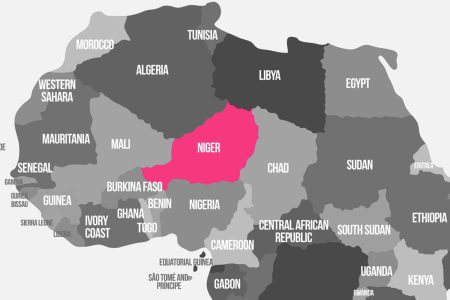
Taking advantage of the opportunity, the foreign ministers of Mali, Burkina Faso, and Guinea, who arrived in Addis Ababa, pleaded for the lifting of the suspension that these three transitional countries are facing within the AU bodies. The three personalities addressed the Comorian Foreign Minister, Dhoihir Dhoulkamal, whose country will soon take over the presidency of the continental organisation. They especially pleaded for the support of the Union of the Comoros in the process of lifting the sanctions.
“The suspension itself is hindering the mobilisation of partners to address the dual security and humanitarian crisis in our countries, with funding projects in various areas of development slipping through the cracks,” said Burkina Faso’s Foreign Minister, Olivia Rouamba. “It is necessary that we can express ourselves and give the right answers on the real situation of our countries… It is a question of survival against the terrorist hold. It is a question of survival in the face of terrorism. That is why we expect our African organisations to show solidarity with us in our efforts to secure our populations,” she added.
Reacting to the approach of the Malian, Guinean and Burkinabe delegations, the Comorian Minister of Foreign Affairs reassured them that Comoros was ready to listen and to work on the issue. For “this is an African problem and Africa has a duty to work to find ways and means to solve it,” he said.