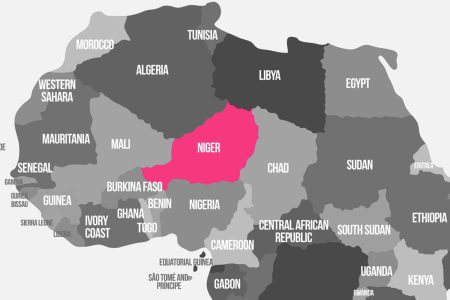
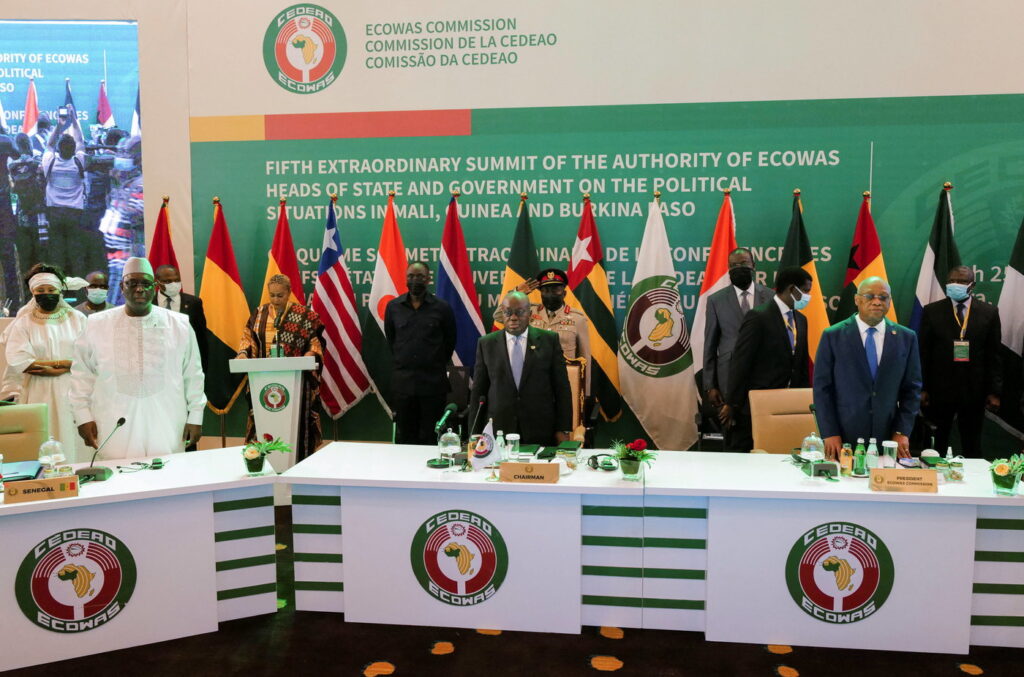
The Economic Community of West African States (ECOWAS) has decided to maintain its sanctions against the three military-led countries following coups in West Africa: Burkina Faso, Mali and Guinea. The decision was taken during a Conference of Heads of State and Government of the Organisation on the margins of the 36th Ordinary Session of the Assembly of the African Union in Addis Ababa, Ethiopia on 18 February. The Organisation also decided “to impose a travel ban on members of the government and other senior officials of the three countries”.
These three West African countries had been suspended by ECOWAS after successive military takeovers in 2020 (Mali), 2021 (Guinea) and 2022 (Burkina Faso). Mali and Guinea were also subject to other sanctions, most of which have since been lifted. “The Conference of Heads of State decides to maintain the existing sanctions against the three countries and to impose a travel ban on members of government and other senior officials of the three countries,” the communiqué signed by ECOWAS President Umaro Sissoco Embalo said.
Furthermore, the Assembly of Heads of State took note of the reports presented on the implementation of the transition roadmaps in Burkina Faso, Guinea and Mali. It also noted with concern the serious security and humanitarian challenges in the three countries, particularly in Burkina Faso and Mali.
Duration of the transition…
With regard to Burkina Faso, the Assembly of Heads of State and Government takes note of the report presented by the ECOWAS Mediator and welcomes the signing of a Memorandum of Understanding between Burkina Faso and ECOWAS on the establishment of the monitoring and evaluation mechanism of the 24-month transitional period in the country.
In the case of Guinea, the Conference of Heads of State drew attention to the consolidated 24-month transition timetable covering the ten priority areas developed jointly with ECOWAS for the transition authorities. It called on the Guinean authorities to respect the spirit of the agreement signed on 21 October 2022. To this end, the Organisation strongly urges the Guinean authorities to conduct an inclusive national dialogue with all political actors and to guarantee the security and freedom of all participants and instructs the President of the ECOWAS Commission to accompany the process.
As far as Mali is concerned, the Assembly of Heads of State and Government took note of the content of the report on the transition process and the establishment of a joint mechanism for monitoring and evaluating the transition timetable, comprising the government, ECOWAS, the AU, the UN, the ECOWAS Mediator, a Steering Committee and a Technical Committee. The Conference instructs the Chairperson of the Commission to continue to support an inclusive transition process in Mali and to keep the Heads of State informed.
It should be noted that in these three countries, the return to constitutional order is theoretically scheduled for 2024 in Mali and Burkina Faso, and 2025 in Guinea. The Assembly of Heads of State and Government therefore calls on the United Nations, the African Union and all international partners to support the implementation of ECOWAS decisions concerning the three countries.