Dr. Lassane Ouedraogo
Research Fellow, CDD West Africa
@Lassaneo
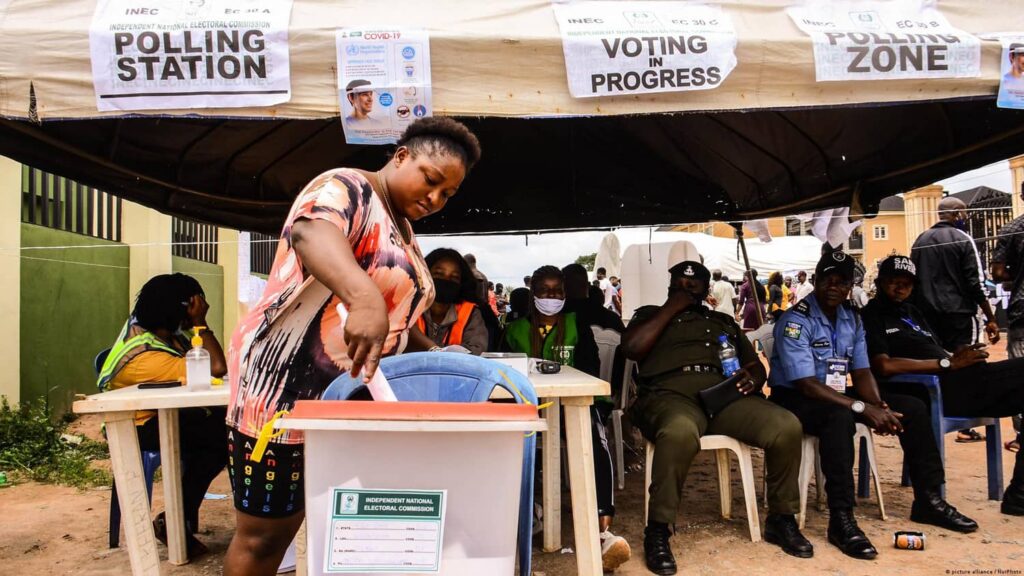
On 25 February, Nigerians go to the polls to elect a successor to President Muhammadu Buhari. After two consecutive terms at the helm of the country since 2015, Buhari leaves behind a mixed record with an economy that is faltering under the weight of inflation but also an endemic level of insecurity across the country.
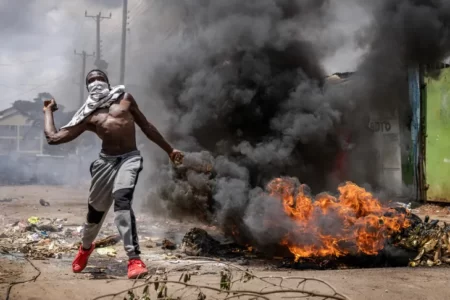
With just three weeks to go before the elections, the level of insecurity is becoming increasingly worrying. There is a strong fear that the electoral process could be subject to major disruptions in some areas, which could jeopardise the outcome of the elections.
The resurgence of several terrorist groups
In addition to the Boka Haram terrorist group in the North East, there are other notorious bandit groups in states such as Zamfara, Kaduna, Katsina, and Sokoto in the North West. These armed militias are mostly born out of ethnic conflicts between Fulani herders and Hausa farmers. In the South East, it is IPOB, the Igbo secessionist group that seems to be resurfacing to perpetuate the threats. IPOB and its many factions are demanding the release of their leader Nnamdi Kanu who has been under arrest since 2015. Despite the fact that in 2021 a federal court tried Nnamdi Kanu and ordered his release, he is still in detention.
Until then, these groups carried out kidnappings and terrorised the population. But recently attacks on the offices of the Independent Electoral Commission, especially in the South East, have been on the increase. More recently, four people were killed in an attack on 12 December on the premises of the Independent Electoral Commission in Owera, Imo State. The institution reports that between 2019 and 2022, it suffered at least 50 attacks on its premises in various states. In Anambra, Enugu, Abia, Ebonyi, and Imo States, hardly a day goes by without the media reporting an incident of kidnapping or killing by bandits. According to the ACLED project, which monitors incidents of violence across the country, in the first 21 days of 2023 alone, there were 3,897 incidents that led to 1,0647 casualties.
A divisive zoning principle
Ethnic, religious and regional cleavages, it should be noted, further fuel this poisonous climate. Throughout the election campaign, Nigerians have indeed had the opportunity to hear from all the eighteen (18) parties, their candidates, especially the four leading candidates. However, what has often fuelled media debates is the origins and affiliations of the candidates rather than their social programs.
For example, the candidate of the ruling APC, Ahmed Bola Tinubu, is a Muslim and Yoruba from the South West. This former governor of Lagos and business tycoon has a push that power must return to the South. He is one of the founding fathers of the APC party. However, Christians object to his choice of Kashim Shettima, a Muslim from Borno State, as his running mate against the electoral tradition that Muslim candidates should choose a Christian vice president and vice versa.
Rabiu Kwankwaso of the NNPP is also from the North. Former Minister of Defence under Olusegun Obasanjo one of the most political states. He was a senator from Kano State under the APC banner. His vice is a Christian from the Edo State.
Atiku Abubacar of the PDP is a Muslim from the North East. A former vice-president of Olusegun Obasanjo, he is making his fifth bid for the top job. Like the incumbent, he is ethnically Fulani and has chosen Ifeanyi Okowa, a Christian and governor of Delta, a wealthy southern state, as his running mate. However, people in the South see him as a traitor, as he could help to send power to the North.
On the other hand, Peter Obi of the Labour Party, which claims to be the vanguard party for the working class and poor masses, has a lot of sympathy among the young, educated and urban strata in Nigeria. The 61-year-old former governor of Anambra State deserted the opposition PDP to join the Labour Party and become its candidate. Peter Obi is Igbo, Christian and from the South East. The Igbo feel marginalised in federal politics and feel that it is time for one of their own to take the reins of power.
Social media involvement
This violence is also discursive, especially on social networks. The number of active social media users in Nigeria has increased from 27 million in 2019 to 36 million in 2023. In such a context, disinformation on social networks takes on a worrying dimension with capacities.
The political parties even have their battalions on social networks. Atiku Abubacar of PDP benefits from the Atikulated Youth Force and the Buhari Media Center exists since the 2019 elections. Some of the Buhari Media’s cyber warriors have rallied behind Bola Ahmed Tinubu’s BATified. All these groups are supplanted by Peter Obi’s Obidients. While these groups feed into the online political debate, there has been an increase in sophistication and organisation in the push for disinformation on social networks. Efforts generally focused on glorifying or delegitimising political candidates and undermining the credibility of the Independent National Electoral Commission (INEC) further inflame the pre-election climate.
Beyond the violence that feeds uncertainty about the actual holding of the elections, it should be noted that there is really no fear of external threats in these elections. Furthermore, the introduction of technology into the voting system seems to increase the confidence of Nigerians in the electoral system. The main problem is then insecurity.
Thus, the eventual winner of this election will have the heavy responsibility of restoring the confidence of Nigerians in the institutions, and of bringing together a country whose socio-economic divide is visibly open.